
What Are We Noticing? A Different Way to Understand Organizational Challenges

When something is not working within an organization, it is natural to want to identify the problem quickly.
Who dropped the ball?
Which process is broken?
Why are we still having this conversation?
Sometimes the answer seems obvious. Staff need to communicate better. Leadership needs to make a decision. A program needs clearer outcomes. A partnership needs more accountability.
And sometimes those things are true.
But I have found that what looks like the problem is often only one piece of what is happening.
A team may appear resistant to change when they are actually unclear about what is being asked of them. A process may look inefficient because it was created for an organization that has since doubled in size. A program may struggle to show its impact because no one agreed on what success should look like in the first place.
This is why I often begin with a different question:
What are we noticing?
A question that creates room to understand
“What are we noticing?” may sound simple, but it changes the conversation.
It moves us away from immediately deciding what is wrong and gives us room to look more closely.
What keeps coming up in meetings? Where are people confused? What work is being repeated? Which decisions keep getting delayed? Where are staff quietly creating workarounds just to keep things moving?
Those details matter.
They help us see the difference between an isolated frustration and a pattern. They also help us understand whether the challenge is connected to clarity, alignment, systems, capacity—or, as is often the case, some combination of all four.
For example, an organization may believe it has a communication problem. But when we look more closely, we may notice that staff are receiving different directions from different leaders. Meetings are happening, emails are being sent, and everyone is certainly communicating. The deeper issue is that people are not aligned around who makes which decisions or what takes priority.
Sending another email probably will not fix that.
When everything is a priority
One pattern I see often is an organization trying to hold too many priorities at the same time.
Each priority may be important on its own. The problem is that new work gets added without anything else being paused, changed, or removed. Staff are expected to improve programs, strengthen partnerships, respond to funding opportunities, collect more data, and manage the everyday work that already fills their time.
Eventually, everything becomes urgent.
And if everything is a priority, nothing is really a priority.
This can easily look like a staff performance or time-management problem. But the deeper issue may be that the organization has not made clear choices about what matters most right now.
Prioritizing is not simply creating a list of important things. It means making decisions. What needs attention first? What can wait? What are we willing to stop doing? What can the organization realistically carry with the people, time, and resources available?
Without those choices, staff are left to make individual decisions about competing demands. People may work harder and longer, but the organization still does not move forward in a focused way.
Noticing that pattern gives leaders better information. Instead of asking why people are not getting everything done, they can ask whether the organization has clearly defined what “the most important work” actually is.
Practice the pause
I often encourage people to practice the pause.
Usually, I use that phrase when emotions are high and there is a risk of reacting before we understand what is happening. Pausing gives us a moment to notice what we are feeling, consider what else may be going on, and choose how we want to respond.
The same idea can be useful in strategy.
Organizations are often under pressure to respond quickly. A new opportunity appears. A funder asks for something different. A partner brings forward an idea. A challenge becomes urgent, and suddenly the organization is moving toward a solution before anyone has stopped to ask how it fits with everything else.
Practicing the pause does not mean avoiding decisions or slowing everything to a crawl. It means creating enough space to make an intentional choice instead of an automatic one.
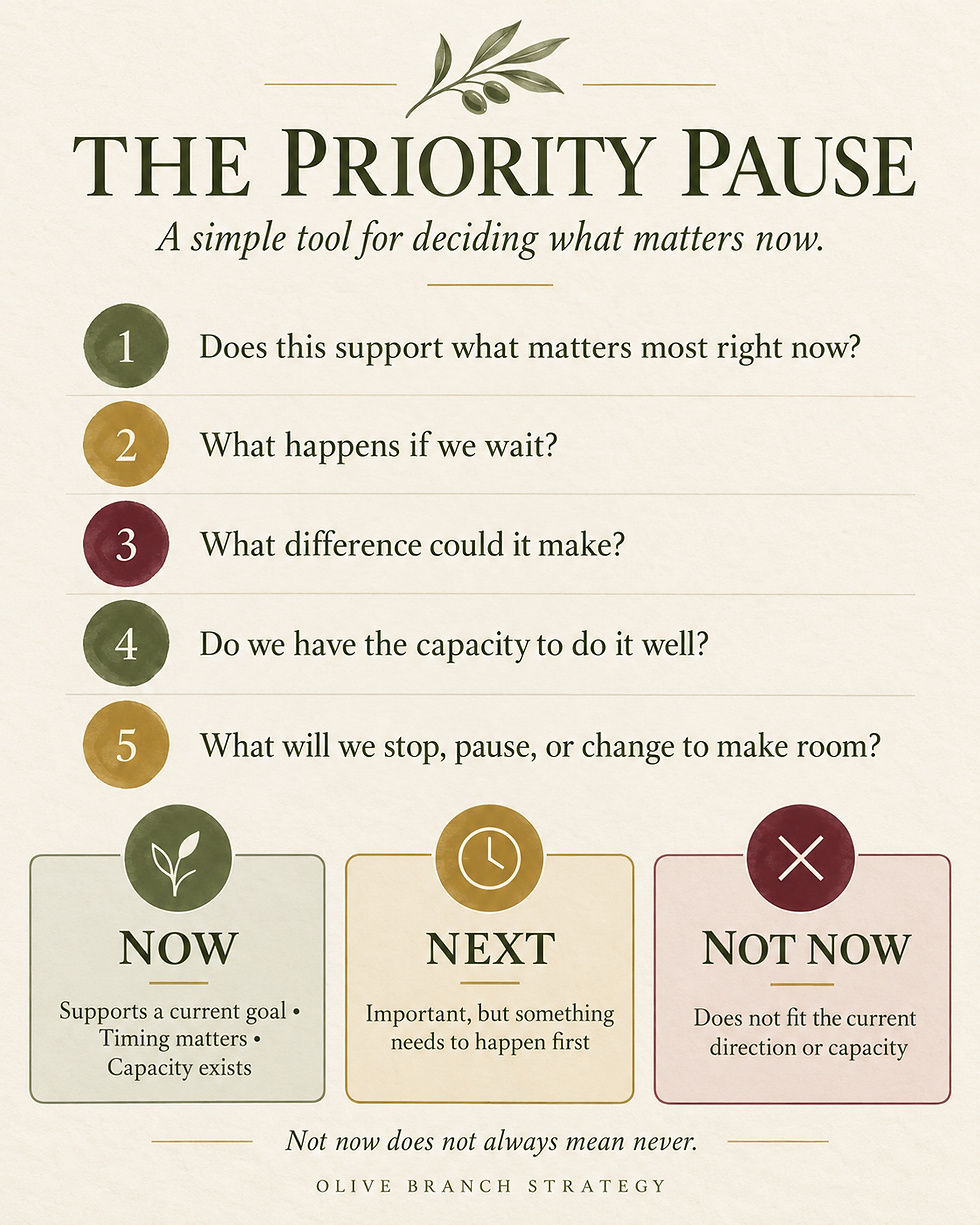
Before adding another priority, pause and ask:
Does this support what matters most right now?
What happens if we wait?
What difference could it make?
Do we have the capacity to do it well?
What will we stop, pause, or change to make room?
These questions make up what I call the Priority Pause.
Once you have talked through them, place the idea, request, or project into one of three categories:
Now: It supports a current goal, timing matters, and the organization has the capacity to give it the attention it needs.
Next: It is important, but something needs to happen first or capacity needs to become available.
Not now: It does not fit the current direction, the likely impact does not justify the resources required, or the organization cannot realistically carry it right now.
“Not now” does not always mean “never.” It means making an intentional choice instead of allowing every good idea to become an immediate obligation.
If everything still lands in the “Now” category, practice the pause again.
That may be a sign that the organization needs a more honest conversation about capacity, tradeoffs, and what matters most.
Curiosity is not the same as avoiding hard conversations
Taking a curious, nonjudgmental approach does not mean pretending everything is fine.
It does not mean lowering expectations, excusing harmful behavior, or avoiding accountability. In fact, real curiosity often helps organizations have more honest conversations because people are less focused on defending themselves and more willing to look at what is actually happening.
The goal is not to remove responsibility. It is to understand responsibility within the full context of the organization.
Organizations are human systems. They are shaped by people, relationships, processes, resources, history, and the environment around them. When one part changes, other parts are affected—sometimes in ways that are easy to see and sometimes in ways that are not.
A new program may be a good idea but create more work than the current team can reasonably carry. A leadership transition may expose decisions that were never clearly documented. A partnership may have strong relationships but no shared process for following through.
None of these situations can be fully understood by looking for one person or one process to blame.
Sometimes the most useful first step is simply slowing down long enough to see the situation more clearly.
Once we understand what is really happening, we can make better decisions about what comes next. And often, the way forward is not as complicated as it first appeared.

Comments